
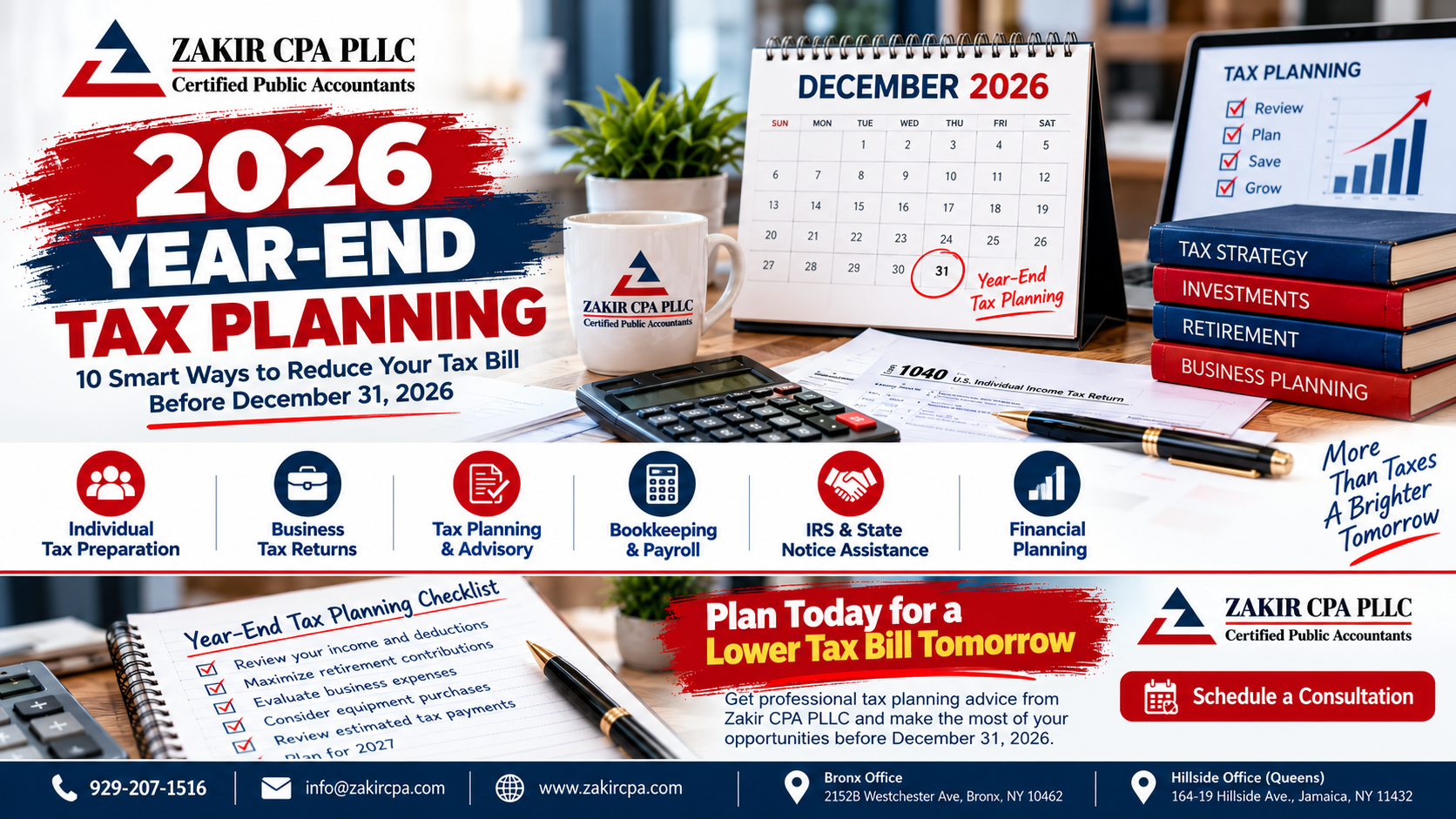
2026 Year-End Tax Planning: 10 Smart Ways to Reduce Your Tax Bill Before December 31
Published: October 29, 2026
By: Zakir CPA PLLC
Category: Tax Planning | Individual Taxes | Small Business Taxes
As 2026 comes to an end, now is the perfect time to review your finances and identify opportunities to reduce your tax liability before December 31.
Many taxpayers wait until tax filing season to think about deductions and credits. However, by then, some valuable tax-saving opportunities may already be gone.
Whether you’re an employee, self-employed professional, landlord, or small business owner, taking action before year-end can make a meaningful difference.
At Zakir CPA PLLC, we help individuals and businesses understand their tax obligations, identify eligible deductions, and prepare for the upcoming tax season.
Here are 10 important year-end tax planning strategies to consider for 2026.
1. Maximize Your Retirement Contributions
Contributing to a retirement account can help build long-term savings while potentially reducing your taxable income.
For 2026, the general employee contribution limit for 401(k), 403(b), and most governmental 457 plans is $24,500, with additional catch-up contributions available to eligible individuals.
The IRA contribution limit is $7,500, with a $1,100 catch-up contribution for individuals age 50 or older.
Traditional retirement contributions may provide tax deductions depending on your income, workplace retirement coverage, and other eligibility requirements.
Tax planning tip: Review your retirement contributions before your final payroll of the year. Some IRA contributions can be made until the applicable tax filing deadline.
2. Review Your Business Expenses Before December 31
Small business owners should review their income and expenses before the year ends.
Common potentially deductible business expenses include:
Office rent and utilities
Advertising and marketing
Business insurance
Professional accounting and legal fees
Software subscriptions
Office supplies
Business-related travel
Employee wages and eligible benefits
Expenses generally must be ordinary and necessary for your business to qualify.
Tax planning tip: Review your bookkeeping records and identify missing expenses. Avoid purchasing unnecessary items simply to obtain a tax deduction.
3. Consider Equipment Purchases and Depreciation
If your business needs computers, machinery, furniture, or other equipment, year-end planning may help you determine the best time to make those purchases.
Certain qualifying business assets may be eligible for Section 179 expensing or bonus depreciation.
Under federal tax law changes enacted in 2025, 100% bonus depreciation was restored for certain qualifying property acquired and placed in service after January 19, 2025.
However, eligibility depends on the asset, acquisition date, business use, and applicable tax rules.
Tax planning tip: Buying equipment is not always enough. Property generally must be placed in service to qualify for depreciation, and state tax treatment may differ from federal rules.
4. Review Your Estimated Tax Payments
Self-employed individuals, independent contractors, landlords, and investors may need to make estimated tax payments throughout the year.
If you have not paid enough tax through withholding or estimated payments, you may face an underpayment penalty.
Review your projected annual income, deductions, credits, and tax payments.
Tax planning tip: If your income increased significantly in 2026, review whether an additional estimated payment or increased payroll withholding would be appropriate.
For calendar-year taxpayers, the fourth federal estimated tax installment for 2026 is generally due January 15, 2027.
5. Evaluate Capital Gains and Investment Losses
Investors should review their investment portfolios before December 31.
Selling investments at a loss may help offset taxable capital gains. If capital losses exceed capital gains, individuals may generally deduct up to $3,000 of net capital losses against other income annually, or $1,500 if married filing separately.
Unused qualifying losses may generally be carried forward.
However, wash-sale rules can disallow certain losses when substantially identical securities are purchased within the applicable period.
Tax planning tip: Review investment gains and losses before selling securities. Tax considerations should be balanced with your overall investment goals.
6. Plan Your Charitable Contributions
Charitable giving may provide tax benefits while supporting organizations and causes that matter to you.
For 2026, eligible taxpayers who do not itemize may deduct up to $1,000 in qualifying cash charitable contributions, or $2,000 for married couples filing jointly, subject to applicable requirements.
Taxpayers who itemize may also qualify for charitable contribution deductions, although additional limitations apply.
Keep donation receipts and required acknowledgments.
Tax planning tip: Make qualifying year-end donations before December 31 and maintain proper documentation. Contributions must generally be made to eligible organizations.
7. Review Health Savings Account Contributions
If you have eligible health coverage, a Health Savings Account (HSA) can offer valuable tax benefits.
For 2026, the general HSA contribution limits are:
$4,400 for self-only coverage
$8,750 for family coverage
Eligible individuals age 55 or older may contribute an additional $1,000.
Actual contribution eligibility can depend on coverage, enrollment in Medicare, and other factors.
Tax planning tip: Review your HSA contributions and eligibility. Qualifying contributions for 2026 can generally be made until the applicable federal tax filing deadline in 2027.
8. Understand Important 2026 Tax Law Changes
Recent federal tax legislation introduced several changes affecting deductions, credits, and year-end planning.
For 2026, the basic standard deduction amounts are:
| Filing Status | 2026 Standard Deduction |
|---|---|
| Single | $16,100 |
| Married Filing Jointly | $32,200 |
| Head of Household | $24,150 |
| Married Filing Separately | $16,100 |
Additional deductions may apply to eligible taxpayers, including certain older individuals.
Other provisions address qualified tips, overtime compensation, and interest on certain qualifying vehicle loans.
Important: Some energy-related tax credits have expired. For example, the federal Energy Efficient Home Improvement Credit and Residential Clean Energy Credit generally are no longer available for new qualifying 2026 expenditures or installations.
Tax planning tip: Do not assume that a deduction or credit available in 2025 remains available in 2026.
9. Review S-Corporation Payroll and Owner Compensation
If you own an S-Corporation and work in the business, year-end payroll planning is especially important.
The IRS generally requires shareholder-employees to receive reasonable compensation for services performed before taking non-wage distributions.
Business owners should review:
Total W-2 wages for 2026
Federal and state payroll tax withholding
Shareholder distributions
Retirement plan contributions
Employee benefits
Business reimbursements
Payroll tax filings
Tax planning tip: Review your compensation and payroll records before the final payroll of 2026. Incorrect payroll treatment can create additional taxes, penalties, or compliance issues.
10. Schedule a Year-End Tax Planning Consultation
One of the most effective ways to prepare for tax season is to review your financial situation before the year ends.
A CPA can help evaluate your income, deductions, estimated payments, business structure, and potential tax liabilities.
A year-end review may help you:
Identify available deductions and credits
Estimate your 2026 federal and state tax liability
Review business profitability
Plan retirement contributions
Evaluate capital gains and losses
Address payroll and bookkeeping issues
Prepare for the 2027 tax filing season
Remember, tax preparation reports what happened during the year. Tax planning helps you make informed decisions before the year ends.
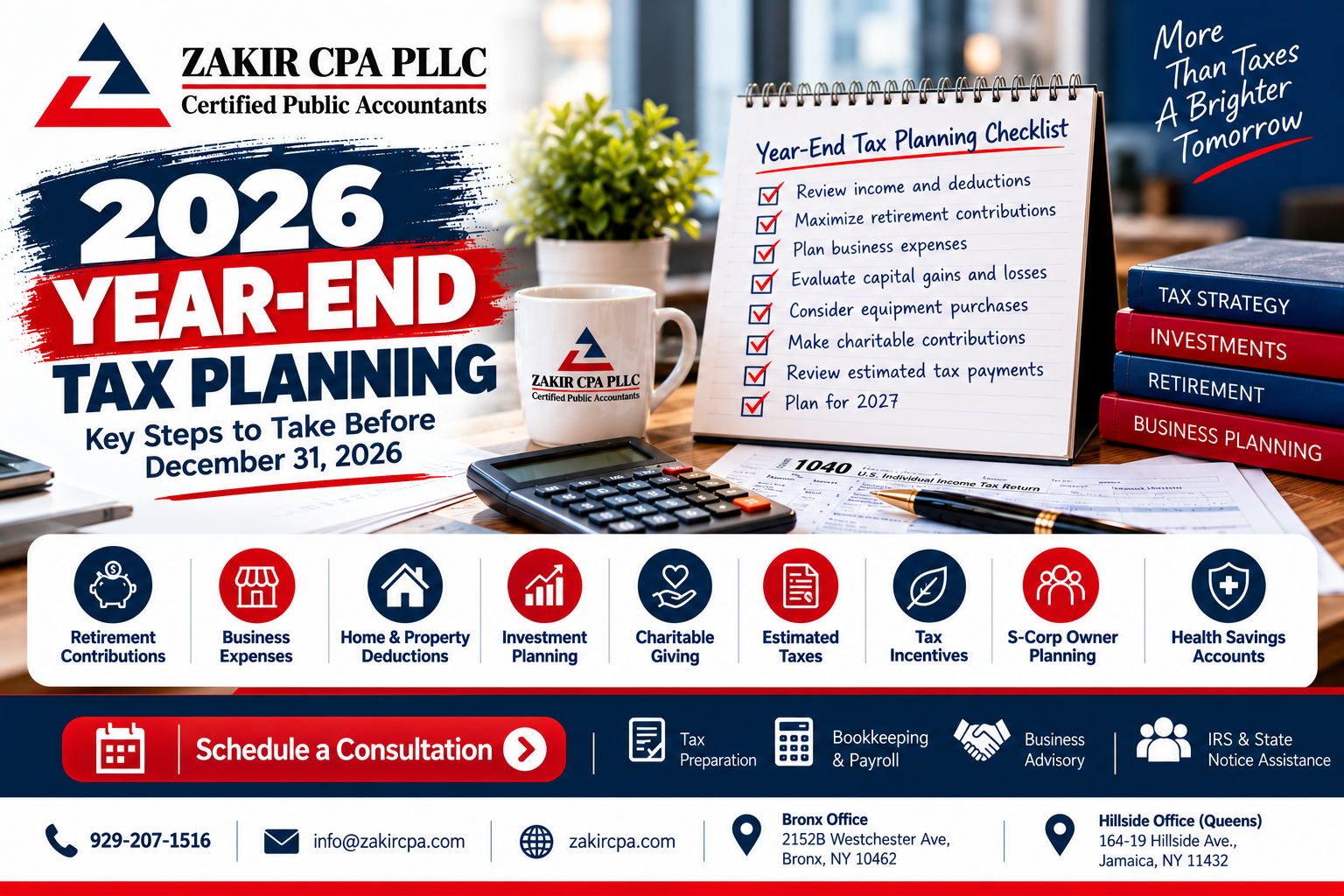
Why Choose Zakir CPA PLLC?
At Zakir CPA PLLC, we provide professional accounting and tax services for individuals, families, self-employed professionals, and businesses.
Our services include:
Individual and Business Tax Preparation
Year-End Tax Planning
Bookkeeping and Financial Statements
Payroll Services
Sales Tax Compliance
IRS and State Tax Representation
Business Formation and Tax Advisory
We serve clients from our Bronx and Queens offices and provide services to eligible clients in other states.
Contact Zakir CPA PLLC Today
Don’t wait until tax filing season to start thinking about your 2026 taxes.
Schedule a year-end tax planning consultation before December 31, 2026.
Zakir CPA PLLC
Bronx Office: 2152B Westchester Ave, Bronx, NY 10462
Queens Office: 164-19 Hillside Ave, Jamaica, NY 11432
Phone: 929-207-1516
Email: info@zakircpa.com
Website: https://zakircpa.com
Numbers Matter. So Do You.
Disclaimer: This article is for general educational purposes only and does not constitute individualized tax or legal advice. Tax deductions, credits, and planning opportunities depend on your circumstances. Consult a qualified tax professional before making financial decisions.